Weld Seam Powder Coating Process
To achieve the best pore-free weld seam coating, a thick protective layer of coating is required. However, when using liquid coatings, a thick layer is prone to forming bubbles during drying and curing, a problem that can only be solved by using powder coatings.
The quality of the weld seam protective layer depends not only on the coating method but also on the welding quality. For example, when welding frequency is low or when using low-tin steel or chromium-plated steel, spatter, surface roughness, and the presence of weld oxides can occur on the weld seam. These defects can cause the coating layer to be damaged during subsequent processes such as flanging, necking, or rolling. Additionally, the thickness of the tinplate and the quality of the sheared sheets also pose challenges for liquid coating touch-up processes.
Although welding equipment has been improved to achieve a better weld seam—by increasing welding frequency, adding auxiliary weld wheels, or using inert gas protection to reduce internal weld spatter—achieving perfect protection with liquid coatings is still difficult, especially as welding speeds increase.
In contrast, powder coating processes produce minimal air pollution during application. Powder coatings can also cover weld spatter (see Figure 3-94). During application, almost all the coating between cans can be fully recovered and reused, resulting in minimal waste. For these reasons, the powder coating touch-up process has been increasingly adopted by Chinese manufacturers in recent years to achieve optimal weld seam protection.
Although the advantages of powder coatings are well known, there are some inconveniences. The powder feed and return tubes must be fixed to the welding arm while still allowing the can body to pass externally. Because the powder tubes are relatively thick, typically 6–8 mm in diameter, special welding arms are required for D52 cans (202) to secure the tubes and allow can passage. This increases can-making costs.
The principle of powder touch-up is as follows: the powder coating is drawn from the powder box into the powder gun by the airflow (based on Bernoulli’s principle, where higher flow speed creates lower pressure). It is then transported through the airflow to the exit of the spray arm nozzle and sprayed onto the weld seam, as shown in Figures 3-95, 3-96, and 3-97.
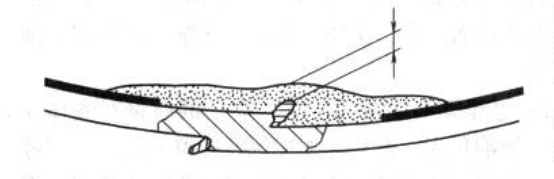
Figure 3-94 Weld Spatter Covered by Powder Coating
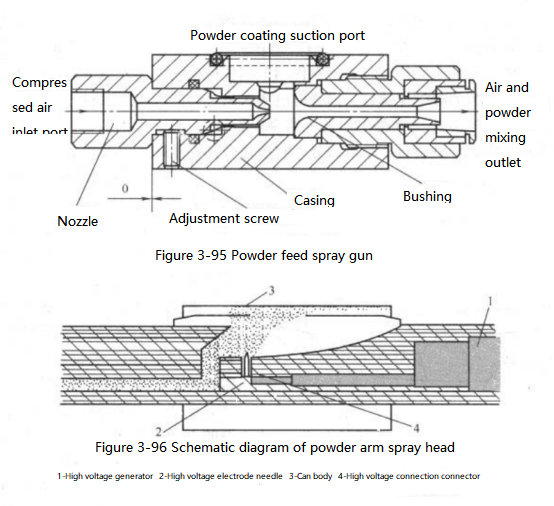
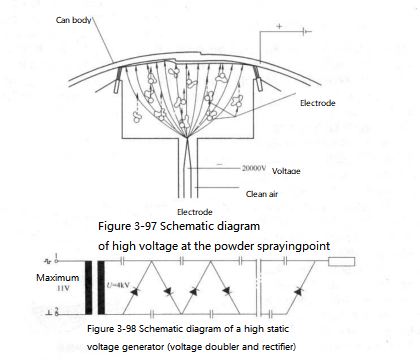
At the exit of the powder spray arm, there is a high-voltage needle that generates a high electrostatic voltage (DC high voltage produced by a voltage multiplier). When the powder passes through the high-voltage zone, the powder particles become charged. Under the combined action of the airflow and the electrostatic field, the powder particles adhere to the can wall in the weld area. At the spray arm nozzle, a pair of lips on both sides acts as a seal to prevent the powder from spreading sideways, forming a neat powder coating strip. The higher the electrostatic voltage, the better the powder’s adhesion. However, if the voltage is too high, it can cause the powder coating strip to become uneven and rough due to repulsion between like charges. Figure 3-98 shows the schematic of the high-voltage generator.
Thermoplastic Powder Coating
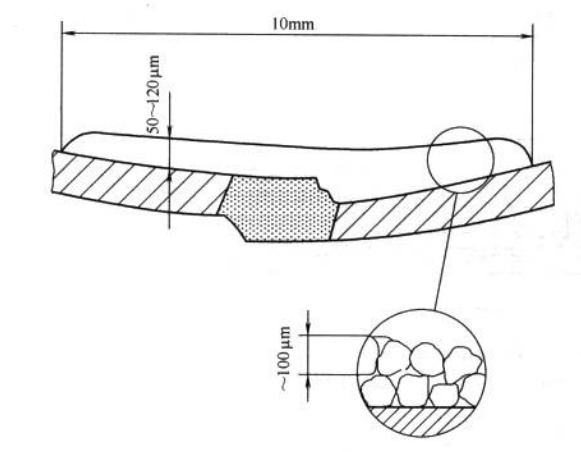
Figure 3-99 Thermoplastic Powder Coating Touch-Up Strip