Repair Coating Curing Ovens
For powder coating and liquid coating repair, the equipment is basically the same. It mainly consists of a heating oven and a conveyor belt. After the can body has been welded and repair-coated, it continuously passes through the oven on the conveyor belt, ensuring that the repair coating strip is properly baked and cured. However, the ovens use different heating methods.
(1) Electric Heating Tube Oven
This oven is equipped with specially designed resistance heating tubes. Airflow generated by a high-pressure fan is blown toward the heating tubes, heated, and then discharged through nozzles onto the welded repair coating area of the can body, thereby baking and curing the coating strip. The temperature of the heating tubes can be controlled by a temperature regulator. The oven temperature can be adjusted between 300–550 °C.
(2) Gas Oven
The gas oven mainly consists of a gas mixing regulator (see Fig. 3-107) and an oven chamber (see Fig. 3-108). Its principle is as follows: the gas is first mixed with air through the gas regulator and delivered via pipelines into the oven, where a second mixing occurs before being discharged. With the ignition of a high-voltage device, a blue flame is produced after proper adjustment, which bakes and cures the repair coating strip. The oven temperature can reach 300–600 °C, making it suitable for powder coating curing. Volatile gases are extracted through exhaust inlets located on both sides.
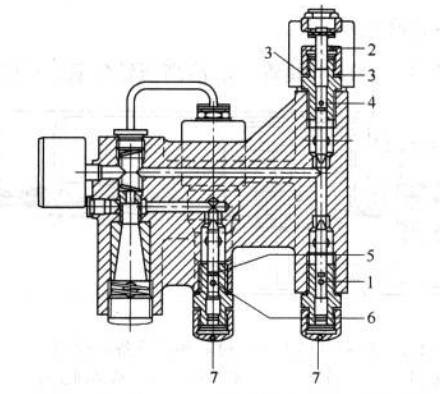
Fig. 3-107 Gas Mixing Regulator
1 – Adjusting bolt 2 – Air inlet adjusting bolt
3 – Lock nut 4 – Valve stem
5 – Gas valve stem 6 – Locking bolt 7 – Sealing cap
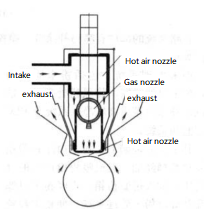
Fig. 3-108 Structure of Gas Oven
(3) High-Frequency Induction Oven
This oven works based on the principle of electromagnetic induction. It is equipped with a set of coils carrying high-frequency current. When in operation, the conductive metal of the can body, particularly near the high-frequency coil or the welded repair coating area, generates eddy currents under the effect of electromagnetic induction. This causes the metal to heat internally, providing the baking and curing effect. This type of oven is suitable for the initial stage of liquid coating, specifically the baking and curing process during solvent evaporation. Since the heat is generated inside the metal itself, it helps the solvent evaporate effectively and reduces the risk of bubbles in the liquid repair coating strip.