Coated Steel Sheet Performance Testing Methods
Testing Method
1. Sample Preparation
The samples for physical and chemical performance testing should be cut with a cutting tool. The sampling position and size are shown in Figure 5-5.
2. Preparation of Test Solution
The test solution should be prepared using analytical-grade reagents and distilled water.
3. Appearance Inspection
a. Light Source: At least two 40W daylight lamps.
b. The distance between the light source and the sample should be 750–800mm, and the distance between the inspector’s eyes and the sample should be 350–400mm for visual inspection.
c. Appearance Requirements:
The coating should be smooth and even, with consistent color, free from soldering defects and charring.
The coating should be free from impurities, bubbles, sand holes, and other defects that affect its use.
The coating should not have scratches that penetrate the surface.
There should be no exposed iron on the plain iron surface due to framework damage or material adhesion.
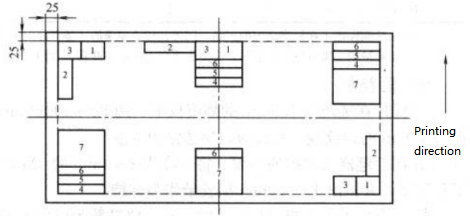
Figure 5-5 Sample Sampling Locations and Dimensions
1. Measure coating thickness (50mm × 50mm)
2. Measure adhesion (120mm × 30mm)
3. Measure corrosion resistance (50mm × 50mm)
4. Measure acid resistance (100mm × 25mm)
5. Measure sulfur resistance (100mm × 25mm)
6. Measure boil resistance (100mm × 25mm)
7. Measure impact resistance (100mm × 100mm)
e. The error in the position and width of the blank space should be less than ±1.0mm, and no material should be present in the blank area.
Coating Thickness
1. Peeling Weight Method (Arbitration Method):
a. Test solution: Sodium carbonate solution (30-50g/L). Weigh 30-50g of anhydrous sodium carbonate, dissolve in water, and dilute to 1000mL.
b. Test procedure:
After cleaning the sample with acetone and air-drying, weigh it using an analytical balance (m). The measurement should be accurate to 0.1mg.
Immerse the sample coated with tin-plated steel sheet in a sodium carbonate solution at 90-95°C, using the sample as the cathode and a stainless steel plate as the anode. Perform the peeling process under a 4-6V DC voltage. Once the coating is completely removed, take out the sample, wash it quickly with water, and dry it. The surface of the tin-plated steel sheet should not show any black discoloration.
For the chrome-plated steel sheet sample, place it flat and repeatedly rub the coating with an acetone-soaked sugar cube. When the coating is almost wiped off, use acetone-soaked cotton to clean the surface debris and let it dry naturally.
Weigh the peeled tin (or chrome)-plated steel sheet sample again (m2). The measurement should be accurate to 0.1mg.
c. Result Calculation: The coating thickness (X) is expressed in terms of coating amount per unit area (g/m²) and can be calculated using the following formula.
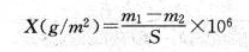
in the formula:
- m₁ — Mass of the sample before film removal, in grams (g)
- m₂ — Mass of the sample after film removal, in grams (g)
- S — Area of the sample, in square millimeters (mm²)
The calculation result should be expressed to one decimal place.
d. The coating thickness of the sample shall be the arithmetic mean of the three measured samples.
② Instrument Method:
Use an electronic coating thickness gauge with a precision of 0.5 g/m² for measurement.
③ Coating thickness is expressed as the coating amount per unit area. The coating amount and within-sheet variation shall comply with the requirements specified
Table 5-4 Coating Amount and Within-Sheet Difference

Note:
(1) For products with coating thickness outside the standard, the within-sheet difference should follow the requirements for the products with thinner coating thickness.
(2) When specific requirements for coating thickness are necessary, they should be agreed upon by both the supplier and the buyer and included in the contract.
(5) Adhesion Strength Test
1. Test Procedure:
The sample is placed on a scratch tester with a pitch of 1.5 mm. The test is conducted at a speed of 90–100 rpm, with a groove length of 60–80 mm and a diameter of 10 mm.
The scratch should penetrate through the coating layer.
2. Adhesion Testing:
Use a brush to remove the scratched coating.
Apply a 25.4 mm wide 3M610 adhesive tape on the scratched area and press it firmly with the index finger, leaving 15–20 mm of the tape as a handle.
3. Peeling:
Press down on one end of the sample while holding the tape. Quickly peel off the tape at a diagonal upward angle, as shown in Figure 5-6.
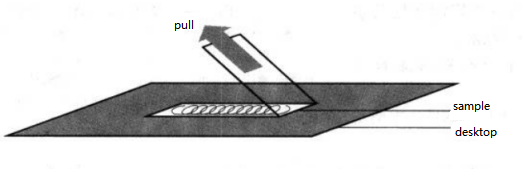
Figure 5-6 Peeling Off Adhesive Tape from the Coating Film
④ Observe the extent to which the coating film within the scratched spiral is peeled off, and evaluate the adhesion strength according to Table 5-5.
For non-stick tinplate (or chrome-plated steel sheets) with a surface coating of synthetic wax, the wax layer must be removed before conducting and evaluating the test according to steps ①–④.
Table 5-5 Adhesion Strength Evaluation

⑤ The adhesion strength of the sample should be the arithmetic average of the measured values from the three test pieces.
⑥ The adhesion strength should comply with the requirements specified
Table 5-6 Adhesion Strength.

Note: For products whose coating thickness is not within the standard, the adhesion shall be implemented according to the regulations for products with thin coating.
(6) Acid Resistance
① Test Solution:
a. Acetic Acid Solution (3%)
Take 30 mL of glacial acetic acid and dilute it with water to a total volume of 1000 mL.
b. Citric Acid Solution (20g/L)
Weigh 20 g of citric acid (C₆H₈O₇•H₂O), dissolve in water, and dilute it to 1000 mL.
② Test Procedure:
a. Fold the tin-plated steel test sample repeatedly into squares with a 3mm gap. Submerge it in an inert container with the test solution, and seal it with a lid. The distance between the test solution and the inner surface of the container lid should be 5–7 mm.
b. Fold the chrome-plated steel test sample repeatedly into squares with a 3mm gap. Submerge it in an inert container with the test solution, and seal it with a lid. The distance between the test solution and the inner surface of the container lid should be 5–7 mm.
c. Place the test container in a pressure cooker, heat to 121°C, and maintain for 30 minutes. After naturally reducing pressure and cooling, remove the sample, wash, and dry it. Observe the coating condition.
③ After the test, the coating should show no bubbles, no peeling, no discoloration, and no whitening.
(7) Sulfur Resistance
① Test Solution:
A mixed solution of L-cysteine hydrochloride (0.5g/L), potassium dihydrogen phosphate (3.6g/L), and disodium hydrogen phosphate (7.2g/L). Weigh 0.5g of L-cysteine hydrochloride (C₃H₈NO₂SCI) or 0.56g of L-cysteine hydrochloride (C₃H₈NO₂SCI•H₂O), 3.6g of potassium dihydrogen phosphate, and 7.2g of disodium hydrogen phosphate (Na₂HPO₄•12H₂O). Dissolve each in water, mix, and dilute to 1000 mL. The mixed solution should be used within 4 hours after preparation.
② Test Procedure:
a. Fold the test sample repeatedly into squares with a 3mm gap. Submerge it in an inert container with the test solution, and seal it with a lid. The distance between the test solution and the inner surface of the container lid should be 5–7 mm.
b. Place the test container in a pressure cooker, heat to 121°C, and maintain for 60 minutes. After naturally reducing pressure and cooling, remove the sample, wash, and dry it. Observe the coating condition.
③ After the test, the coating should show no obvious sulfur spots and no peeling.
(8) Boiling Resistance
① Fold the test sample repeatedly into squares with a 3mm gap. Submerge two test samples in an inert container filled with distilled water, and place the other two in an inert container without water.
② Place the test container in a pressure cooker, heat to 121°C, and maintain for 30 minutes. After naturally reducing pressure and cooling, remove the sample. Observe the coating condition.
③ For products with coatings on the outer surface, after the test, the coating should show no bubbles, no peeling, no discoloration, and no whitening.
(9) Corrosion Resistance
① Test Solution:
A mixed solution of citric acid (50g/L), sodium nitrate (0.14g/L), and ascorbic acid (0.5g/L). Weigh 50g of citric acid (C₆H₈O₇•H₂O), 0.14g of sodium nitrate, and 0.5g of ascorbic acid. Dissolve each in water, mix, and dilute to 1000 mL. The mixed solution should be used within 4 hours after preparation.
② Test Procedure:
a. Solder a wire to the back of the sample, and coat the back and edges with molten beeswax.
b. Submerge the sample in the test solution. Use a 4mm diameter, 10mm length stainless steel rod as the cathode, with the sample as the anode, and connect to a 15V DC power source to cause anodic corrosion. After 1 hour, remove the sample, wash, and dry it. Observe the size and number of corrosion spots.
③ The corrosion resistance of the sample is evaluated according to Table 5-7 Corrosion Resistance.
Table 5-7 Corrosion resistance evaluation
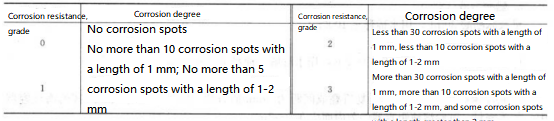
④ The corrosion resistance of the sample should be the arithmetic mean of the values measured on three samples.
⑤ For certain specific products, other corrosive media may be used with the consent of both parties.
⑥ The corrosion resistance should comply with the provisions of Table 5-8.
Table 5-8 Corrosion resistance

Note: For sulfur-resistant coatings, Class C products, and products with coatings on the outer surface, this index is not required.
(10) Impact Resistance
① Test Solution:
Copper sulfate solution (50g/L): Weigh 50g of copper sulfate (CuSO₄•5H₂O), dissolve in water, and dilute to 1000mL.
② Test Procedure:
a. Insert the test sample face down into an impact tester. Use a 1 kg weight hammer to drop it from a height of 1 meter, or impact the sample to form a lid with a diameter of 60–90mm. During the impact, the steel substrate should not be damaged.
b. Immerse the impacted sample or lid in the copper sulfate solution. After 30 minutes, remove the sample, wash, and dry it. Observe the corrosion condition on the hemispherical impact surface or lid.
③ After the test, the coating should show no concentrated corrosion spots.